J. of Fluids and Structures: A high-order fluid-structure interaction framework with application to shock-wave/turbulent boundary-layer interaction over an elastic panel
Our newest paper titled on fluid-structure interaction is out in the Journal of Fluids and Structures!
It discusses our developments of an FSI framework with HO DG and how shock / boundary layer interaction becomes more challenging and interesting over elastic walls.
More details below, and congratulations to all involved!
Abstract
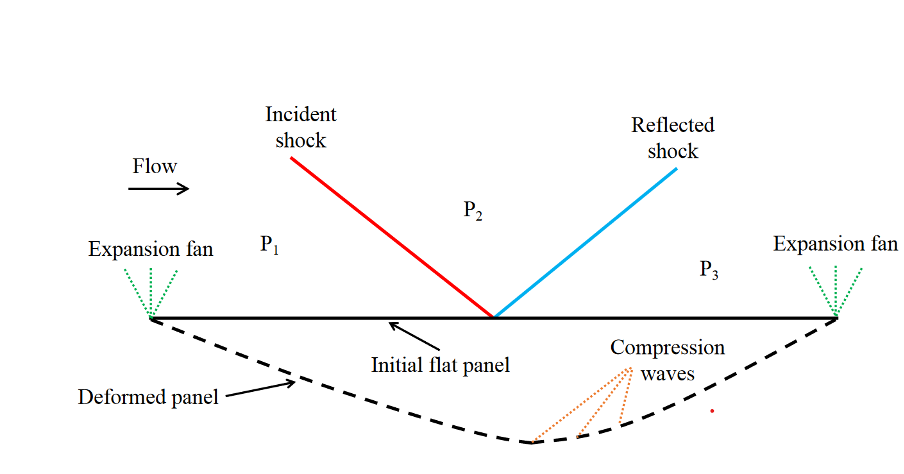
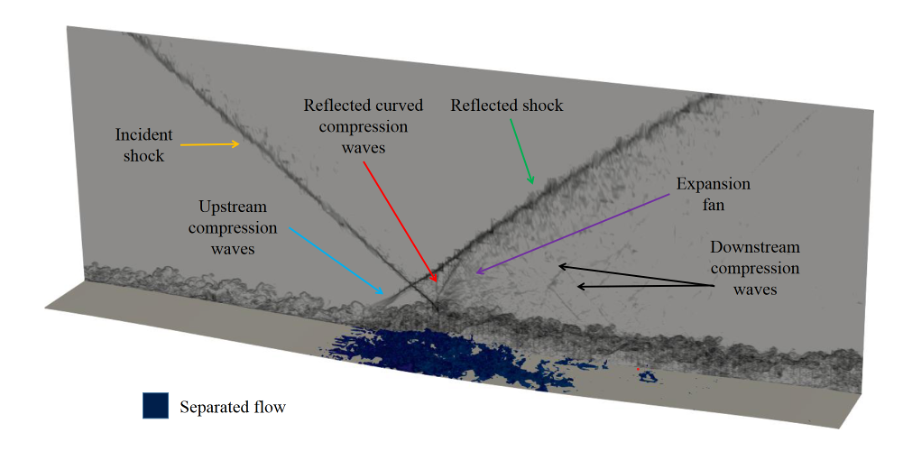
Within this work, a loosely coupled high-order fluid-structure interaction (FSI) framework is developed in order to investigate the influence of an elastic panel response on shock-wave/turbulent boundary-layer interaction (SWTBLI). Since high-order methods are expected to determine the future of high-fidelity numerical simulations, they are employed in the construction of both fluid and structure solvers. Specifically, a split-form arbitrary Lagrangian-Eulerian discontinuous Galerkin spectral element method is employed in the fluid solver and a Legendre spectral finite element method in the structure solver. A zonal large eddy simulation technique, relying on a turbulent inflow method and a non-reflecting outflow boundary condition, is used to model under-resolved turbulence efficiently. Shock capturing by an improved adaptive filter method, which confines the filtering effect to the vicinity of shocks, is found to be well-behaved in accuracy, efficiency and flexibility. After being validated by two benchmark FSI problems, the developed FSI framework is applied to simulate SWTBLI over an elastic panel. A comparison with a previous simulation of SWTBLI over a rigid panel reveals that:
1) A larger amplitude of the pressure variation, observed on the elastic panel surface, implies a larger threat to the structural integrity;
2) The shock-induced separation flow over the elastic panel changes both in size and shape, leading to a different skin-friction coefficient distribution;
3) A new low-frequency flow unsteadiness of the same magnitude as the elastic panel vibration is detected, which may affect the flow dynamics inside the turbulent boundary layer;
4) The separation-induced low-frequency flow unsteadiness over the elastic panel is detected inside a larger streamwise extent, consistent with the larger streamwise extent of the separation flow region.
Link